
The Illinois State Police at a Glance
The Bureau of Identification, often called BOI, is Illinois's central repository for criminal-history record information. It sits within the Illinois State Police Division of Justice Services and its Criminal Justice Services Command. The Criminal Identification Act authorizes identification, reporting, dissemination, record review, challenges, and implementation of expungement and sealing orders. The Uniform Conviction Information Act, or UCIA, creates the separate public route for ISP-maintained conviction information.
BOI's work includes biometric identification through the Automated Biometric Identification System, criminal-history maintenance, civil fingerprint processing, court-disposition integration, and support for authorized justice users. ISP says ABIS supports records tied to more than five million fingerprint files. That is a measure of files in the biometric system, not a count of five million people with convictions.
The official ISP Bureau of Identification overview identifies the repository and its specialized services.
The agency overview helps separate BOI record support from court-file, police-report, and jail-record services held elsewhere.
ISP Criminal History From Cards to ABIS
Illinois State Police began in 1922. State legislation authorized the Bureau of Criminal Identification and Investigation in 1931, and the identification operation began with about 30,000 fingerprint cards in 1932. Automated Fingerprint Identification System technology arrived in 1989. UCIA took effect on January 1, 1991 and established the modern public-conviction channel. Later live scan and ABIS technology sped the movement and comparison of fingerprint data.
Administrative rules for Access and Review were modernized in 2015. Technical materials reflected the move from AFIS language to ABIS by 2018. ISP created the present Division of Justice Services structure in 2020. These changes improved identification and access, but they did not transfer original county files to BOI. A circuit clerk still keeps pleadings and certified judgments. The arresting agency still keeps its narrative report.
What Checks Illinois State Police Offers
ISP products differ by legal authority, identity method, and scope. CHIRP provides an electronic name-based UCIA conviction inquiry. Paper UCIA forms provide manual alternatives. Fingerprint products may return Illinois or combined Illinois and FBI results when a statute and authorized requestor permit that channel. Access and Review is distinct: it is the subject-only way to receive and challenge one's own Illinois transcript.
The official ISP background-check product page sets the UCIA public boundary.
The product description confirms that public conviction information is not an unrestricted release of every BOI file.
| Product | Who May Order | What It Returns | Cost |
|---|---|---|---|
| CHIRP electronic UCIA name inquiry | Any requester under UCIA | Illinois conviction information matched to supplied identifiers | $10 |
| Manual UCIA name inquiry | Any requester under UCIA | The statutory conviction product through paper processing | $16 |
| Electronic UCIA fingerprint inquiry | Appropriate fingerprint requester | Fingerprint-matched Illinois conviction information | $15; $10 qualifying resubmission |
| Manual UCIA fingerprint inquiry | Appropriate fingerprint requester | Fingerprint-matched Illinois conviction information through card processing | $20 |
| Electronic State-only fee-applicant product | Statutorily authorized program or requestor | Illinois fingerprint result for the authorized purpose | $15; $10 qualifying resubmission |
| Electronic FBI-only fee-applicant product | Statutorily authorized program or requestor | FBI fingerprint result for the authorized purpose | $12; $10 qualifying resubmission |
| Electronic State and FBI product | Statutorily authorized program or requestor | Authorized combined Illinois and FBI fingerprint result | $27; $20 qualifying resubmission |
| Manual State and FBI product | Authorized requestor | Combined Illinois and FBI result through paper-card processing | $32 |
| NCPA/VCA and Adam Walsh volunteer product | Qualifying statutory requestor | National and state child-protection fingerprint result | $25; $20 qualifying resubmission |
| Access and Review | The record subject | Own Illinois transcript or no-record statement and challenge route | No ISP fee; vendor fee may apply |
| Petition to expunge or seal | Court and petitioner workflow | ISP processing connected to the petition | No ISP fee; county filing fee separate |
| Expungement or sealing order | Court-order workflow | BOI implementation of a transmitted court order | $60 |
| Criminal-history subpoena | Proper subpoena process | Authorized criminal-history production | $20 |
ISP CHIRP Conviction Search Limits
The Criminal History Information Response Process, or CHIRP, is the electronic UCIA name-inquiry portal. It uses the identity details supplied by the requester and charges $10. Name matching may consider name-derived values with sex, race, and date of birth, not just one exact spelling. That can reduce spelling misses, yet it also can produce multiple possible matches. Fingerprints remain the sound way to establish positive identity.
The official ISP CHIRP portal is the entry point for electronic conviction inquiries.
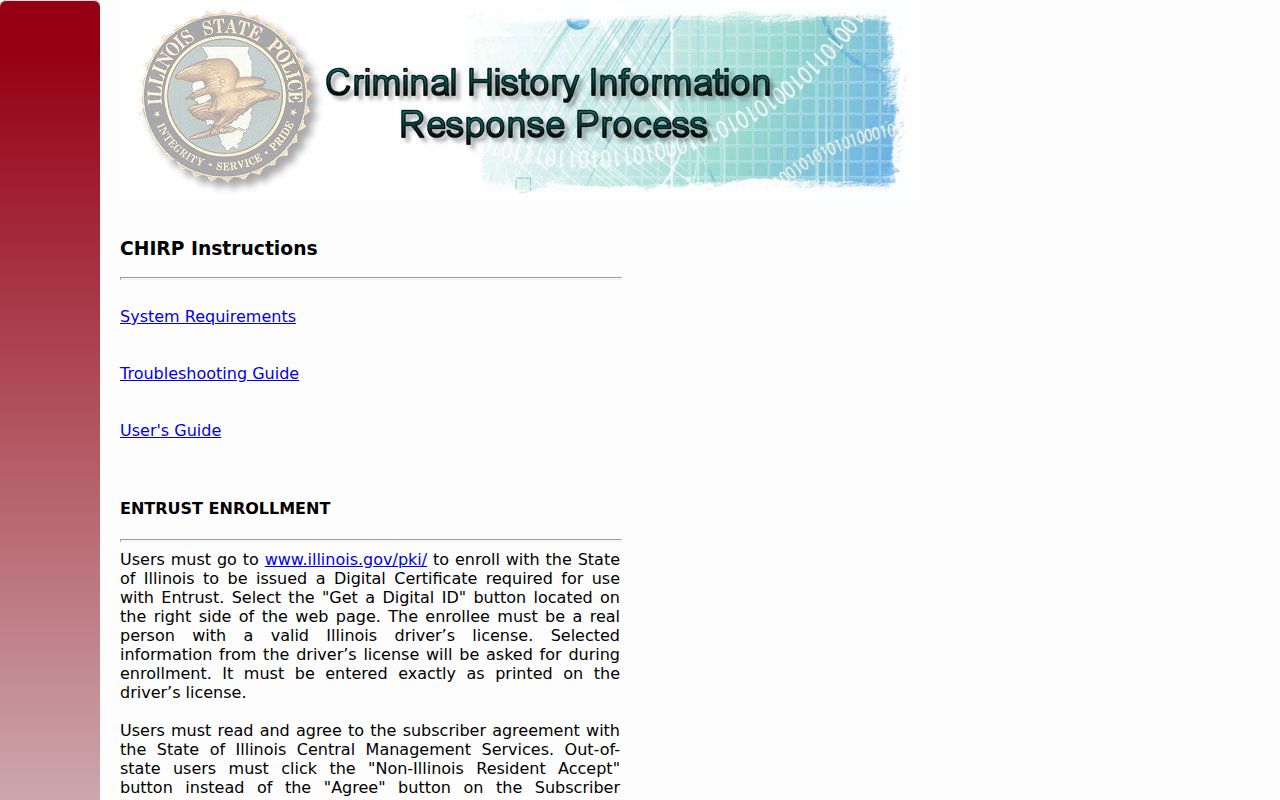
The portal is a paid request and retrieval system, not an open browser for every Illinois arrest or court case.
| CHIRP Control | Type | Required | Purpose |
|---|---|---|---|
| Last Name | Text | Yes | Supplies the legal surname for matching. |
| First Name | Text | Yes | Helps reduce common-name collisions. |
| Middle Name or Initial | Text | Varies | Adds a narrowing identifier. |
| Date of Birth | Date or text | Expected | Provides a core identity match point. |
| Sex and Race | Coded choices | Portal dependent | May narrow candidates. |
| Payment | Card or account | Yes | Pays the $10 electronic name-inquiry fee. |
| TCN | Text | For retrieval | Tracks the transaction and retrieves the response. |
A no-record response means no responsive public Illinois conviction match was found from the supplied data. It does not prove there was no arrest, declined charge, pending case, sealed event, or county disposition not yet reflected at BOI.
The Path Into the ISP Repository
A reportable Illinois arrest begins a fingerprint transaction. The arresting agency sends fingerprints, identifying data, and charges to ISP. A transaction control number, or TCN, tracks that submission. When the fingerprint identity links to an existing Illinois State Identification number, the new arrest cycle can be added to that person's statewide biometric record. Prosecutors, circuit clerks, sheriffs, IDOC, and other reporting bodies later send qualifying events.
Data flow: County Arrest › Fingerprint Submission › Illinois State Police Bureau of Identification › Court Disposition Reporting › Rap Sheet.
The court disposition must connect to the right arrest cycle. A paper-era outcome, incomplete identifier, delayed report, or changed charge can break the link. Under current reporting law, covered agencies generally have 30 days to provide events unless a more specific rule applies, while arresting agencies submit covered fingerprints and charges daily. BOI also updates its reportable Criminal Justice Statutes file each quarter.
How ISP ABIS Links Illinois Records
ABIS uses biometric data to distinguish people whose names look alike. Three identifiers serve different jobs. The SID follows the fingerprint-supported subject through Illinois events. A TCN follows one submission or inquiry. A county court case number follows one prosecution. Confusing those values can send a status request to the wrong office.
- SID
- The Illinois State Identification number attached to a fingerprint-supported subject record.
- TCN
- The Transaction Control Number that tracks a specific fingerprint or CHIRP transaction.
- Arrest cycle
- The linked arrest charges and later outcomes associated with one fingerprint event.
- Disposition
- The charge-level result, such as conviction, dismissal, acquittal, supervision, or nolle prosequi.
- AOIC code
- An Illinois offense code used for charge classification and reporting attributes.
A rap sheet can show an identity header, arrest segment, court charge and outcome, then a sentence or custody event where reportable. It is still a summary record. It does not carry every hearing, pleading, exhibit, or detailed financial entry in the county court file.
ISP Check Ordering Steps
Start with the question, then select the official channel. CHIRP fits a public Illinois conviction inquiry. Access and Review fits personal transcript review. A fingerprint product for a legally authorized program requires the correct requestor and purpose code. Paper forms remain available for manual and out-of-state card workflows.
- Choose CHIRP, a permitted fingerprint product, or subject-only Access and Review based on the record needed.
- Gather accurate identifiers. For live scan, bring photo identification and the request form with the correct purpose code or ORI.
- Submit through CHIRP, an Illinois-licensed live-scan vendor, or the applicable BOI paper process.
- Pay the stated ISP fee and any separate vendor charge. Keep the TCN receipt for tracking and possible resubmission.
- Save the response and compare any listed case with the county circuit-clerk record before relying on the outcome.
The official ISP Bureau of Identification fee schedule lists current state charges.
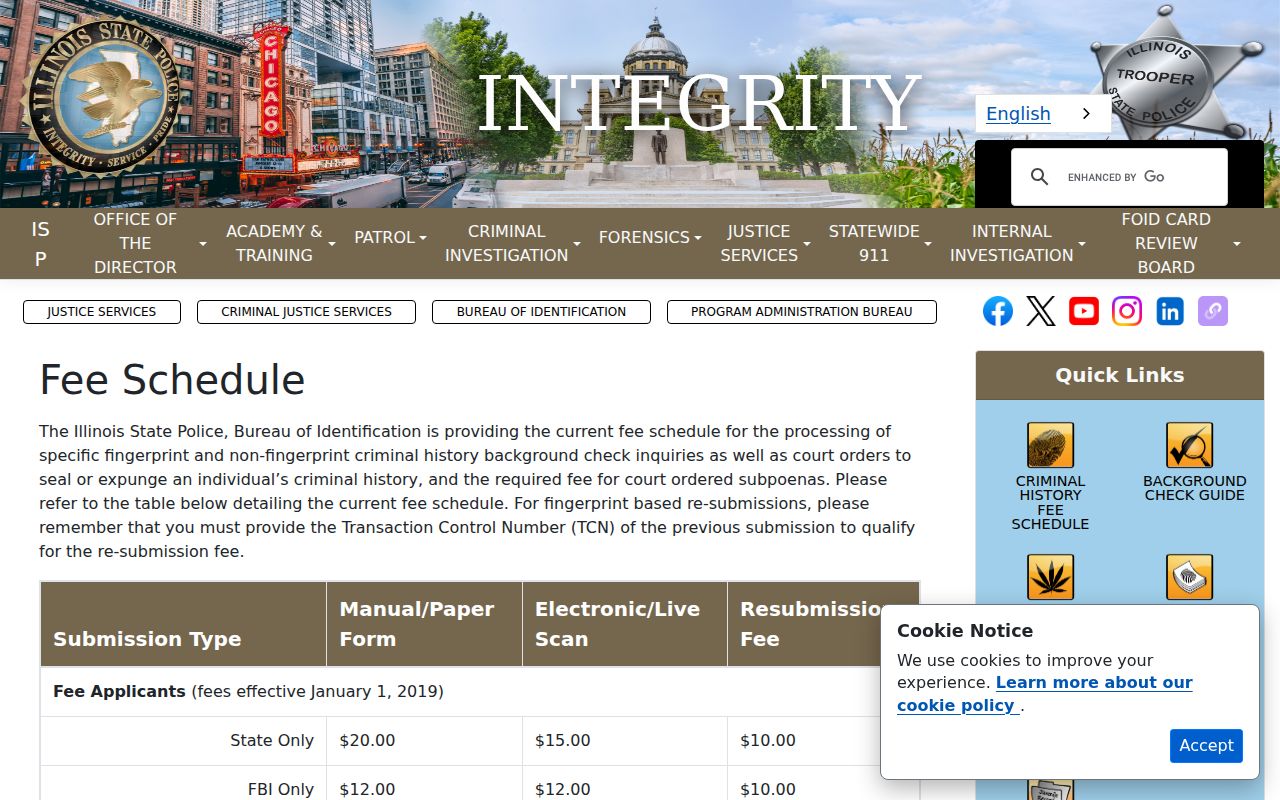
The fee table also shows why the ISP base charge must be kept separate from live-scan capture and county copy costs.
Note: CHIRP UCIA results remain available for 30 days, so retrieve and save a completed response promptly.
ISP Access and Review for Illinois Records
Access and Review is the right channel for examining one's own Illinois transcript. It is fingerprint based and subject only. The applicant selects a licensed vendor, specifies Access and Review, supplies the required identity and mailing details, and keeps the TCN. ISP charges no processing fee, although the private vendor may charge for capture.
The official Illinois licensed live-scan vendor list identifies eligible providers.
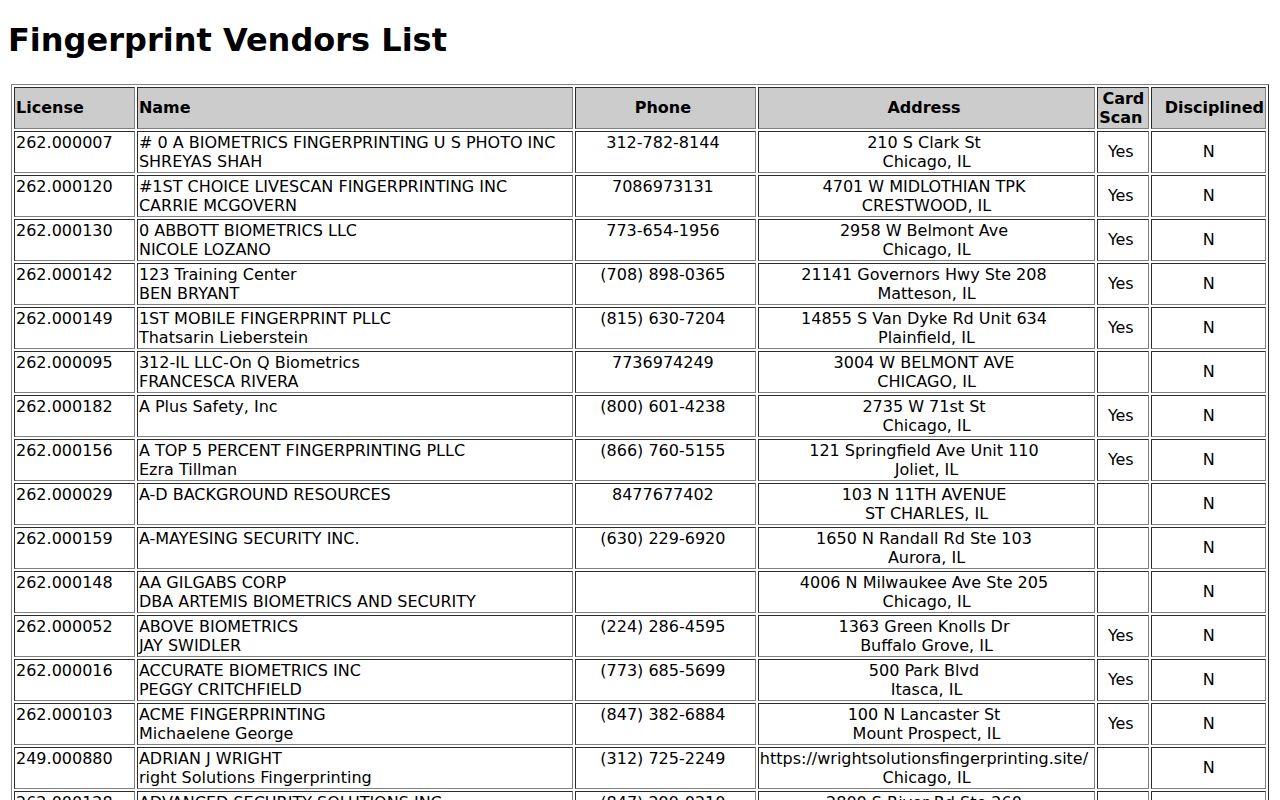
The statewide list helps an applicant choose a licensed capture site while comparing its separate service fee and appointment rules.
Current Part 1210 rules require ISP to send a transcript or no-record statement within seven days after a conforming electronic submission, or within 45 days after a conforming fingerprint card. The result goes to the residential address or permitted designated facility supplied in the transaction. The subject may keep the copy and receives the Record Challenge form needed if an entry appears wrong.
ISP Record Checks and Missing Outcomes
No current official statewide disposition-completeness percentage was found. The absence of that number matters. It prevents a broad claim that every Illinois arrest cycle has a final court result attached. BOI audits record quality and monitors delinquent dispositions, but local reporting and old records can still create gaps.
A June 2026 reporting amendment strengthened the feedback loop. When ISP sends a reporting entity notice of missing, incomplete, or incorrect information, that body generally has 30 days to correct the data or explain the obstacle and give an estimated completion date. This work supports the Illinois Clean Slate implementation because automated sealing depends on accurate outcomes.
A blank disposition should lead to the filing circuit clerk's certified outcome, not a guess about how the charge ended.
Comparing ISP and County Records
An ISP criminal-history check provides statewide reach across reportable events submitted from Illinois counties. The county layer provides the source detail. A circuit clerk can supply pleadings, docket history, signed orders, the sentence, and a certified disposition. A local arresting agency holds its incident narrative. A sheriff or jail keeps the booking and current custody file.
| Question | ISP Check | County Record |
|---|---|---|
| Coverage | Reportable statewide history or the selected UCIA product | One county's original arrest, booking, or case source |
| Identity | Fingerprint supported when the chosen channel uses biometrics | Case and agency identifiers, with fingerprints held in the arrest file |
| Freshness | Depends on submission and matching of reported events | Updates as the local case or custody event occurs |
| Detail | Compiled arrest, charge, disposition, and sentence segments | Pleadings, orders, docket events, narratives, and certified copies |
| Best use | Statewide conviction inquiry or review of one's fingerprint-linked transcript | Proving what happened in a specific case or obtaining the source document |
Use the directory of all 102 Illinois counties to reach the county that created the event. For trial documents, the Illinois court case lookup explains the circuit-clerk route. Neither a CHIRP response nor a county docket should be described as a substitute for the other.
ISP Criminal History Public Access Boundary
UCIA makes Illinois conviction information maintained by ISP available through the statute's prescribed inquiry process. The Criminal Identification Act protects the broader BOI file except where UCIA or another law authorizes release. A verified person has a separate right to review and challenge their own state record. These rules explain why CHIRP and Access and Review cannot be treated as interchangeable products.
Public CHIRP information excludes non-conviction events and material made confidential or restricted by law. Juvenile and sealed matters are not ordinary public results. Expungement and sealing orders move through the Circuit Court, then reach ISP for repository action. Illinois FOIA does not turn BOI into a public reading room for protected rap sheets or county court documents.
Note: A fingerprint UCIA inquiry improves identity matching but remains a conviction product, not the subject-only Access and Review transcript.
ISP Record Error Corrections
A correction begins with the subject's own Access and Review packet. Compare the identity header, aliases, arrest cycles, charges, and dispositions with source documents. A missing final result usually calls for a certified disposition from the circuit clerk. An arrest-data issue may require records from the contributing agency. BOI needs proof from the office that owns the underlying fact.
The official ISP Access and Review and Record Challenge instructions describe the personal-review route.
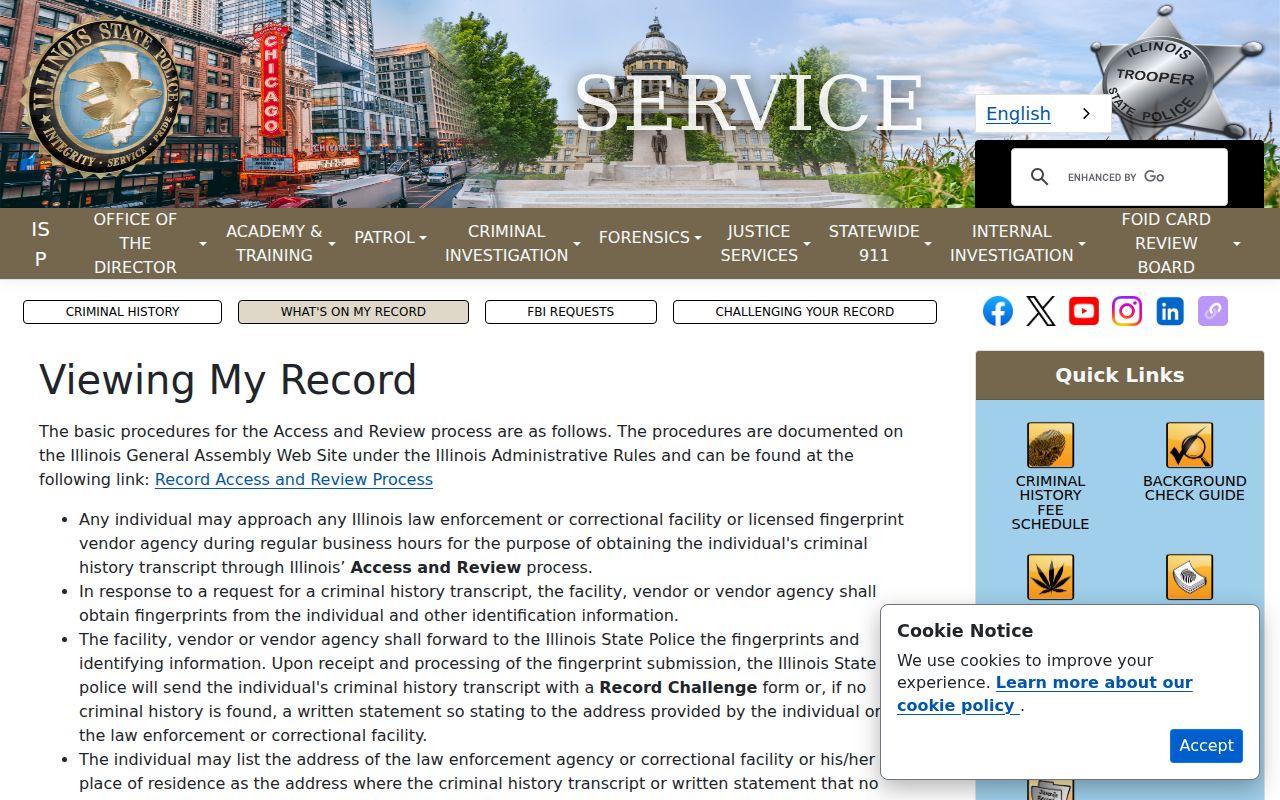
The instructions connect a fingerprint-verified transcript to the challenge form and supporting Illinois source records.
- Request ISP Access and Review through an Illinois-licensed live-scan vendor and keep the TCN.
- Compare each disputed arrest or outcome with the certified county court disposition or creating agency document.
- Complete the Record Challenge form and submit the proof through the instructions supplied by ISP.
- Read ISP's written determination and confirm an approved correction on a later personal record copy.
ISP will explain corrections it makes. If the agency finds no change is warranted, it issues that determination. Clean Slate sealing can also be checked through Access and Review as the phased Illinois process develops.