
Illinois Sex Offender Checks
The Illinois State Police Sex Offender Registry is the official statewide starting point. It publishes records for people whose Illinois convictions, adjudications, or equivalent out-of-state offenses trigger public registration. ISP builds the public database from registration records transmitted through law-enforcement systems. The registry sits beside two related ISP systems, the Murderer and Violent Offender Against Youth Registry and the Missing Sex Offenders List, but each has its own legal scope.
An Illinois registry result is narrow. It shows qualifying sex-offender status and selected Illinois registration facts. It does not provide the person's full criminal history, all court pleadings, or an individual risk score. The Illinois county circuit clerk holds the conviction file. ISP's conviction-check channel covers a different Illinois record product. Those boundaries matter when a name appears or when an expected result does not.
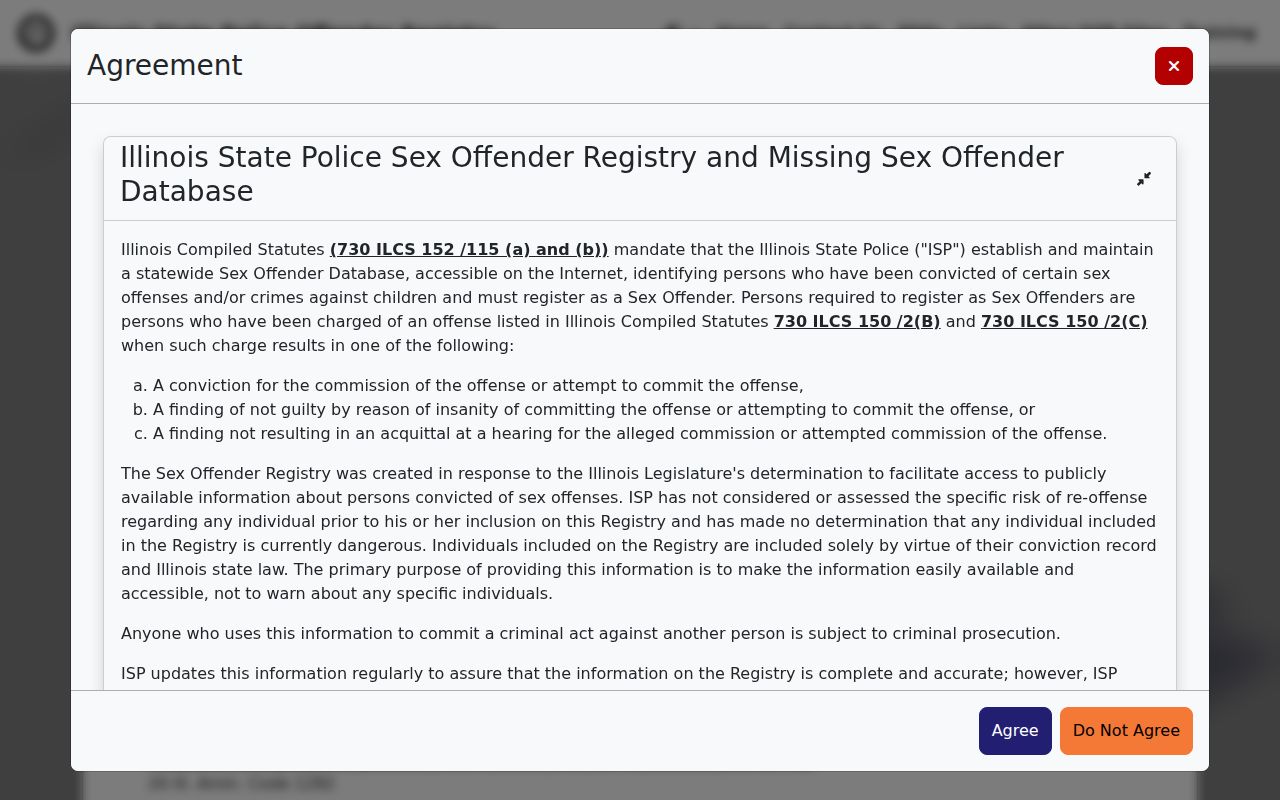
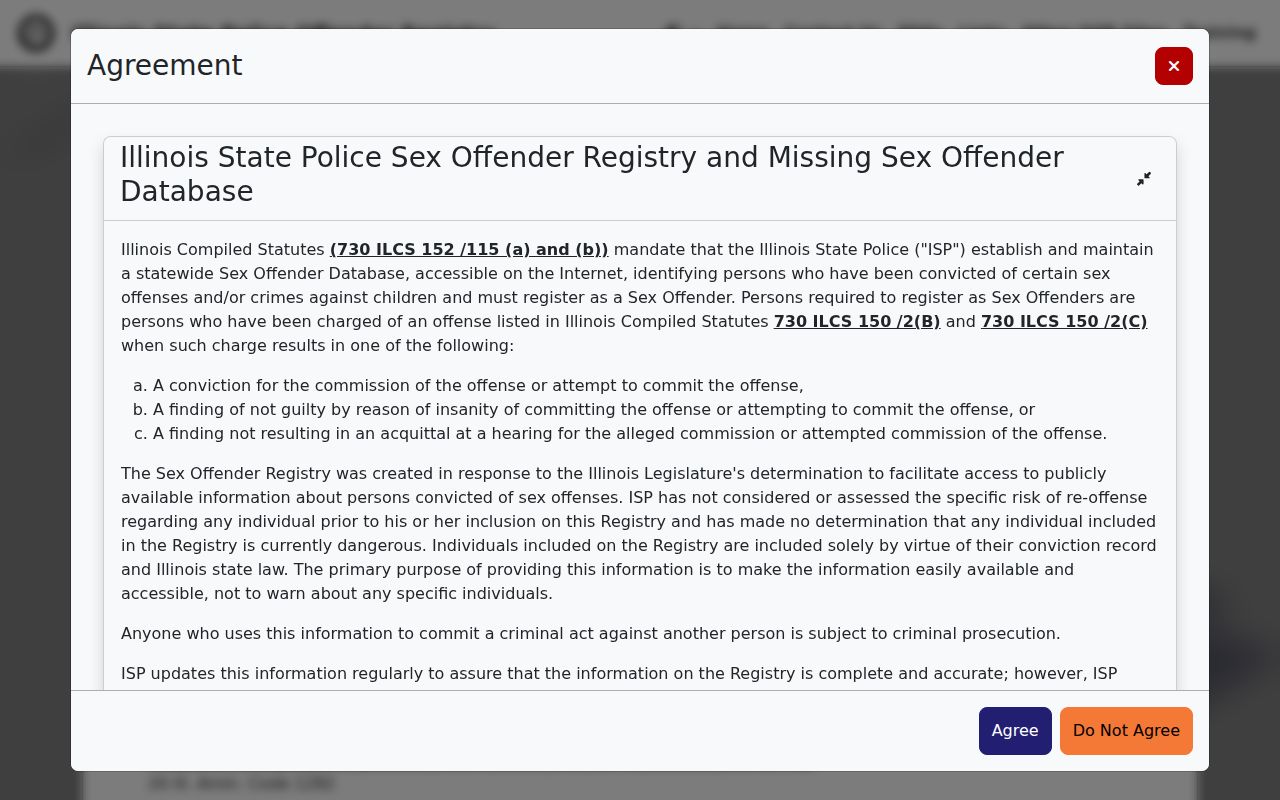
The official ISP registry entry and disclaimer places its Illinois legal and accuracy warnings before public access.
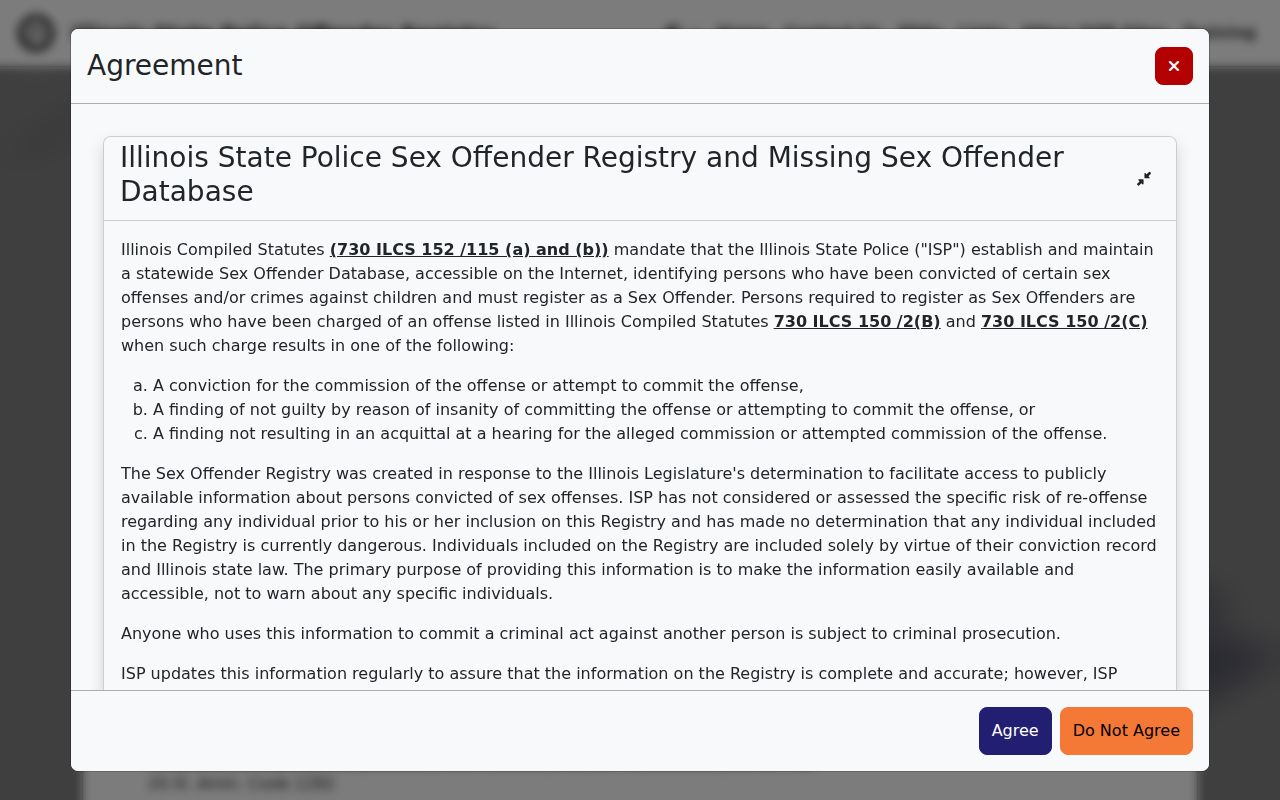
That warning is part of a sound Illinois lookup because it rules out risk predictions, warranties of accuracy, and retaliation based on a profile.
Illinois Offender Registration Routes
Illinois registration happens locally even though Illinois publishes one statewide list. A person generally appears in person within three days of starting school, establishing a residence, beginning work, or using a temporary domicile in an Illinois county. Within a municipality, the police chief or designated office handles registration. In an unincorporated area, or where no chief exists, the Illinois county sheriff performs that role. Chicago uses a superintendent-designated fixed location.
Illinois local agencies take identifying information, verify addresses, update photographs, and transmit changes to ISP. A person without a fixed residence reports weekly and gives the Illinois places stayed during the prior seven days. Address, school, work, telephone, and Internet-identifier changes generally must be reported within three days. The initial and annual Illinois registration fees are each $100, subject to an indigence waiver by the primary registration agency.
The ISP Offender Registration Unit overview identifies the state unit that administers the statutes and rules.
Its Illinois role complements, rather than replaces, the police and sheriff offices that collect and verify Illinois registration data.
Illinois State Police Sex Offender Registry Search Steps
The Illinois public portal accepts a broad name search and several Illinois place or status filters. ISP advises starting with first and last name, then narrowing with date of birth, city, ZIP, county, or status. A common name should never establish identity by itself. Compare aliases, birth information, the photograph, physical descriptors, and the Illinois registering agency shown in the Details view.
- Open the official ISP public portal and accept its disclaimer.
- Enter a first and last name, or begin with a city, ZIP, county, or neighborhood map.
- Narrow a long result list with date of birth, compliance status, homeless status, or an Illinois offender category.
- Open Details and compare the photograph, aliases, descriptors, address status, and registering agency before treating it as a match.
The current Illinois registry interface provides the official search and map controls.
The controls support a free Illinois search without an account or a per-search fee.
| Field Label | Type | Required | Search Use |
|---|---|---|---|
| First Name | Text | Unspecified | Start with the first and last name, then narrow. |
| Last Name | Text | Unspecified | Alias matching may expand the Illinois results. |
| Date Of Birth | Date or text | Optional | Helps separate common names. |
| City / ZIP Code | Text | Optional | Limits results by an Illinois place. |
| County, Incarcerated or Out of State | Dropdown | Optional | Includes every Illinois county plus two noncounty choices. |
| Status / Homeless / Offender Type | Dropdowns and checkbox | Optional | Filters compliance, fixed-residence status, or Illinois category. |
| Map Your Neighborhood | Address map | No | Maps registry records within the statutory five-mile range. |
| Email Proximity Alerts | Not offered | No | No statewide ISP address-alert signup was verified. |
Illinois Registry Map Limits
The Illinois map can search an entered address or a clicked point. Yellow markers represent registry records, and selecting a marker opens a detail pane. State law directs ISP to provide a mapping system that identifies registered offenders living within five miles of an entered address. The research did not verify a menu of selectable one-, two-, or five-mile radiuses, so five miles is the statutory extent, not a promised choice of distances.
An Illinois marker does not decide whether a residence is lawful. Illinois restrictions can turn on the person's statutory category, the type of property, conviction dates, exceptions, grandfather provisions, and local ordinances. The Illinois child-sex-offender provisions use property-line measurements for specified 500-foot rules, while other registrants may fall under different duties. Exact compliance calls belong with current Illinois law and the responsible agency.
Note: A blank map is not a safety guarantee because data may lag, an address may be wrong, or a record may be nonpublic.
What an Illinois Registry Profile Lists
An Illinois Details record gives enough fields to test identity and understand the registration status. It can show an as-of date, current photograph, name and aliases, date of birth and alias birth dates, physical traits, address or nonstreet status, registering agency, registration dates, and duration. Crime information may include an Illinois category flag, victim and registrant ages at the time of the offense, an offense description, and county of conviction.
| Identity | Name, aliases, date of birth, alias birth dates, sex, race, height, and weight. |
|---|---|
| Photograph | Current image, dated history where available, and the profile's information-as-of date. |
| Residence | Street address or a status such as homeless, out of state, unknown, or in a state department. |
| Registration | Registering agency, original and recent registration dates, and ten-year or lifetime duration. |
| Crime Information | Offense text, conviction county, ages at the offense, and qualifying classification flags where applicable. |
| Compliance | Status and, when applicable, a noncompliance explanation or location-unknown designation. |
The web profile sampled for Illinois did not display a case number, conviction date, sentence, precise statute, vehicles, employer, school, Internet identifiers, or distinguishing marks. Illinois local inspection law authorizes a broader field set. Absence from the Illinois web display does not mean that a registration agency never collects the field.
Illinois Registry Local Inspection
Illinois law supplies an official fallback when the web profile is incomplete. Under 730 ILCS 152/120, municipal police provide information for registrants in the municipality, while sheriffs handle unincorporated county areas. A request may be made in person, in writing, or by telephone. The information must be available within 72 hours or three business days, with a place to inspect or copy it during normal public hours.
Illinois inspection may include a current photograph and address, birth date, conviction county, offense-age facts, vehicle plates, electronic identities, and distinguishing marks. Copy charges cannot exceed actual cost, and hand copying must be allowed. Use the Illinois county directory to reach the right sheriff and circuit clerk, then identify the municipality when city police hold the registration record.
Note: Court and conviction documents still come from the circuit clerk in the county of conviction, not from the registry profile.
Registry Levels and Requirements in Illinois
Illinois does not publish simple Tier I, Tier II, and Tier III labels. It uses state offense and status categories. Duration and in-person reporting frequency follow those Illinois categories, confinement history, and compliance events. A ten-year term generally begins at conviction when the person is not confined, or after parole, discharge, or release when confinement occurred. Certain reconfinement can restart or pause the period, and a registration violation can add a ten-year administrative extension.
The Illinois Sex Offender Registration Act establishes the registration framework.
The Act's Illinois-specific terms should control instead of federal tier shorthand.
| Illinois Category | Duration | Routine In-Person Frequency |
|---|---|---|
| Adult or child sex offender not otherwise lifetime | 10 years | Annually |
| Sexual predator | Natural life | Annually |
| Sexually dangerous person after release or discharge | Natural life | Every 90 days |
| Sexually violent person | Natural life | Every 90 days |
| Qualifying SORA violation conviction | Underlying term with extension rules | Every 90 days |
| Qualifying first-degree-murder registrant | Natural life | Annually |
| No fixed residence | Underlying term | Weekly, plus other duties |
| Adjudicated juvenile delinquent sex offender | Order and statutory petition rules | Registration until terminated; ordinary public display is limited |
Illinois Registration Rules in Practice
Illinois rules govern how ISP and local Illinois agencies carry out registration, verification, category decisions, and appeals. They matter when an out-of-state offense must be compared with Illinois law or when ISP imposes an extension after a violation. An administrative extension is not a new sentence. Its timing follows the statute, including the first registration after the violation.
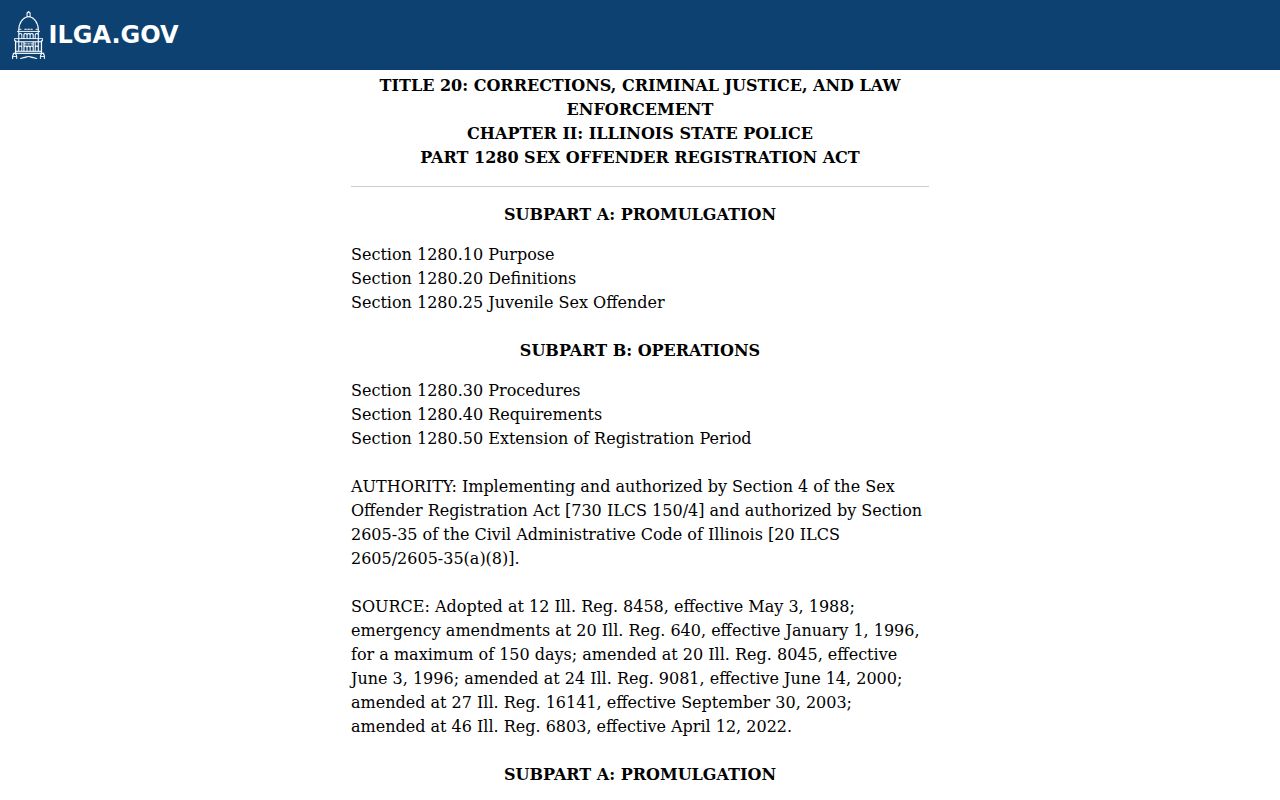
The official Illinois registration rules in Part 1280 provide the current administrative framework.
Anyone disputing duration, equivalency, or category should preserve the registration notice and conviction documents, then use the formal review route rather than asking a search portal to change the legal result.
Note: The named Illinois registering agency remains the first contact when an address, category, or compliance entry appears wrong.
Illinois Registry Versus NSOPW
The U.S. Department of Justice National Sex Offender Public Website searches public records supplied by participating states, territories, the District of Columbia, and tribes. It helps when a person may have moved across state lines. Name search uses first and last name. Location search uses an address, city or town, state, and radius controls. Advanced Search can add more detail.
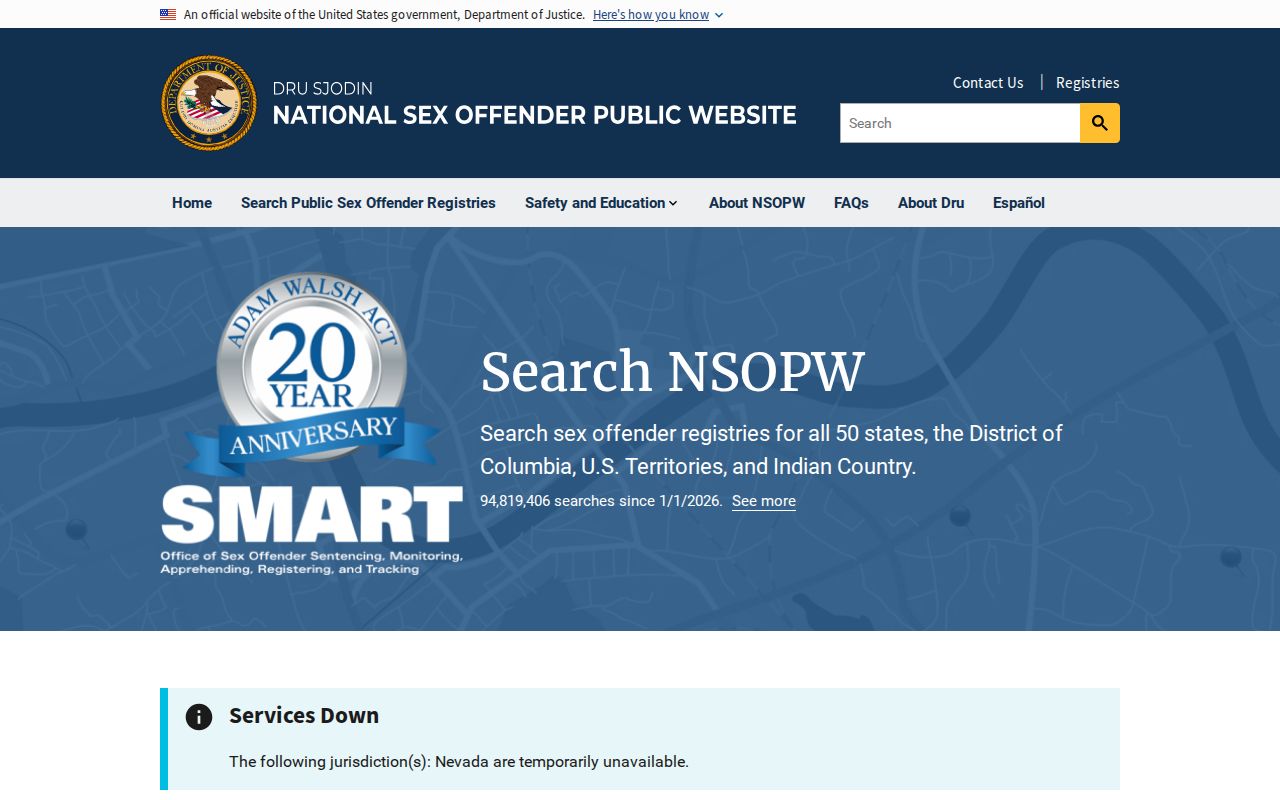
The official NSOPW search is the federal gateway for a multijurisdiction check.
ISP remains the Illinois authority and offers Illinois-specific county, compliance, and category filters. Federal SORNA tiers set national minimum concepts, but they do not replace Illinois public labels.
Illinois VINE is also separate. It provides custody and case notifications by email, text, telephone, or app through participating justice systems. It is not an Illinois neighborhood registry-alert service, and no statewide ISP proximity-email signup was verified.
Using the Illinois State Police Sex Offender Registry Lawfully
Illinois publishes registry information for public safety and community awareness. ISP has not assessed each listed person's chance of reoffending. Inclusion rests on the qualifying record and state law, not a current prediction. The database updates daily, yet some facts come from registrants and local agencies. Missing, inaccurate, or quickly outdated information remains possible.
Community notification is not a promise of door-to-door notice. Illinois law directs information to specified schools, colleges, child-care facilities, libraries, public-housing agencies, victim groups, and organizations serving minors. It also permits special public alerts around certain child-centered holidays. Suspected noncompliance or a known location should go to local police or the sheriff. A suspected profile error belongs with the registering agency shown on the record. The ISP lawful-use disclaimer states the registry's limits, and a search should support careful awareness rather than a conclusion based only on a name, pin, or status label.
Use registry data lawfully. Do not harass, stalk, threaten, or target a registrant or family. ISP warns that harassment and the use of Illinois registry data to commit a crime may be prosecuted under applicable law.
Note: “Location Unknown” means law enforcement verified departure from the last address and does not know the new whereabouts.