
Illinois Criminal History Checks
The right starting point depends on the Illinois record. The Criminal History Information Response Process, or CHIRP, returns Illinois conviction information from the Illinois State Police under the Uniform Conviction Information Act. It is not a full court file or a list of all arrests. A person reviewing their own fingerprint-linked state transcript instead uses ISP Access and Review through a licensed live-scan vendor. A specific prosecution belongs with the circuit clerk in the filing county.
Current Illinois custody requires another split. Illinois county jail sources cover recent booking and local detention. The Illinois Department of Corrections covers state imprisonment and public parole data. The ISP registry covers qualifying registration status. Save accurate names, birth dates, case numbers, booking identifiers, and the county before starting.
- Define whether the goal is a conviction response, personal transcript, case file, booking, custody record, or registry entry.
- Use CHIRP for the public statewide conviction product, or Access and Review for your own Illinois transcript.
- Identify the filing or arrest county for the source docket, certified disposition, report, or booking record.
- Compare several identifiers and read outcomes charge by charge instead of relying on a name alone.
- Order certified documents from the circuit clerk when the exact court result matters.
Note: Match every Illinois result to several identifiers before treating it as the record of the person being researched.
Illinois CHIRP Has Limits
Illinois CHIRP's electronic name inquiry costs $10 and asks for identity data such as last name, first name, date of birth, and other matching details. The requester pays, receives an Illinois Transaction Control Number, and later uses that TCN to retrieve the response. Completed UCIA results remain available in the portal for 30 days, so saving the response promptly matters.
| Field | Use | Key Point |
|---|---|---|
| First and last name | Core identity search | Full legal spelling helps reduce weak matches |
| Date of birth | Distinguishes similar names | An exact date is a strong match aid |
| Sex and race | Portal-dependent descriptors | May narrow candidates |
| Payment | Starts electronic inquiry | Current ISP fee is $10 |
| TCN | Retrieves and traces response | Preserve it after checkout |
An Illinois no-record response means no responsive public conviction match to the submitted identifiers. It does not prove that no Illinois arrest, dismissed count, pending case, sealed matter, or out-of-state event exists. The Illinois filing county remains the source for the underlying disposition.
The Criminal History Repository in Illinois
The Illinois State Police Bureau of Identification is the central Illinois criminal-history repository. Arresting agencies submit covered fingerprints and charges. Prosecutors, circuit clerks, sheriffs, and IDOC report later events. Fingerprints link encounters to an Illinois State Identification number, while a TCN tracks one submission. BOI maintains more than five million fingerprint files in its biometric system, but that figure is not a count of people with convictions.
The public Illinois CHIRP product is narrower than the subject's own transcript. The full Illinois State Police criminal history profile explains UCIA checks, Access and Review, live scan, fees, and record challenges. Illinois county courts still hold pleadings, docket events, orders, exhibits, and certified outcomes that a repository summary does not carry.
Note: The Illinois repository summarizes reportable events, while the filing court preserves the documents that prove the final outcome.
Fixing Illinois Disposition Errors
An Illinois statewide record and an Illinois county case can disagree because a disposition is late, missing, attached to the wrong cycle, or still represented by an old paper entry. The subject should obtain ISP Access and Review, compare each arrest cycle with an Illinois certified circuit-court disposition, then submit the Record Challenge form with supporting proof. ISP charges no processing fee for Access and Review, though the live-scan vendor may charge for capture.
Illinois strengthened that feedback loop in 2026. Under 20 ILCS 2630/2.1, an Illinois reporting entity that receives an ISP notice of missing, incomplete, or erroneous information generally has 30 days to correct it or explain the obstacle and expected completion. The rule supports both accurate histories and later Clean Slate work.
Note: A certified county disposition supplies the best proof of the final charge-level result when the ISP line is blank or stale.
Record Systems Across Illinois
Illinois records are divided by function. The same person may appear in an Illinois jail roster, an Illinois court docket, an ISP arrest cycle, an IDOC profile, and a registry entry, but each source answers a different question. The state has no complete public statewide trial-court criminal index and no complete public warrant search.
| System | What It Holds | Run By |
|---|---|---|
| CHIRP | Public Illinois conviction information | ISP Bureau of Identification |
| IDOC Individual in Custody Search | Current public custody and parole fields | Illinois Department of Corrections |
| ISP Sex Offender Registry | Qualifying statewide registration profiles | Illinois State Police |
| re:SearchIL | Eligible reviewing-court documents and participating access | Illinois Judicial Branch |
| County circuit clerk | Trial-court docket, filings, orders, and certified dispositions | Each county clerk |
Start with the narrowest Illinois matching system. Then use the Illinois county source when the statewide view omits the original report, full docket, booking detail, or certified result.
Note: A result missing from one Illinois system may exist in another because coverage, purpose, and update timing differ.
Illinois Custody Has Three Layers
A recent Illinois arrest usually points first to the Illinois county jail. An Illinois prison commitment points to the IDOC Individual in Custody Search. A federal sentence points to the Bureau of Prisons. Moving from one level to another can make a person disappear from the first tool without ending custody.
The official IDOC search form offers last-name, IDOC-number, and birthdate modes. 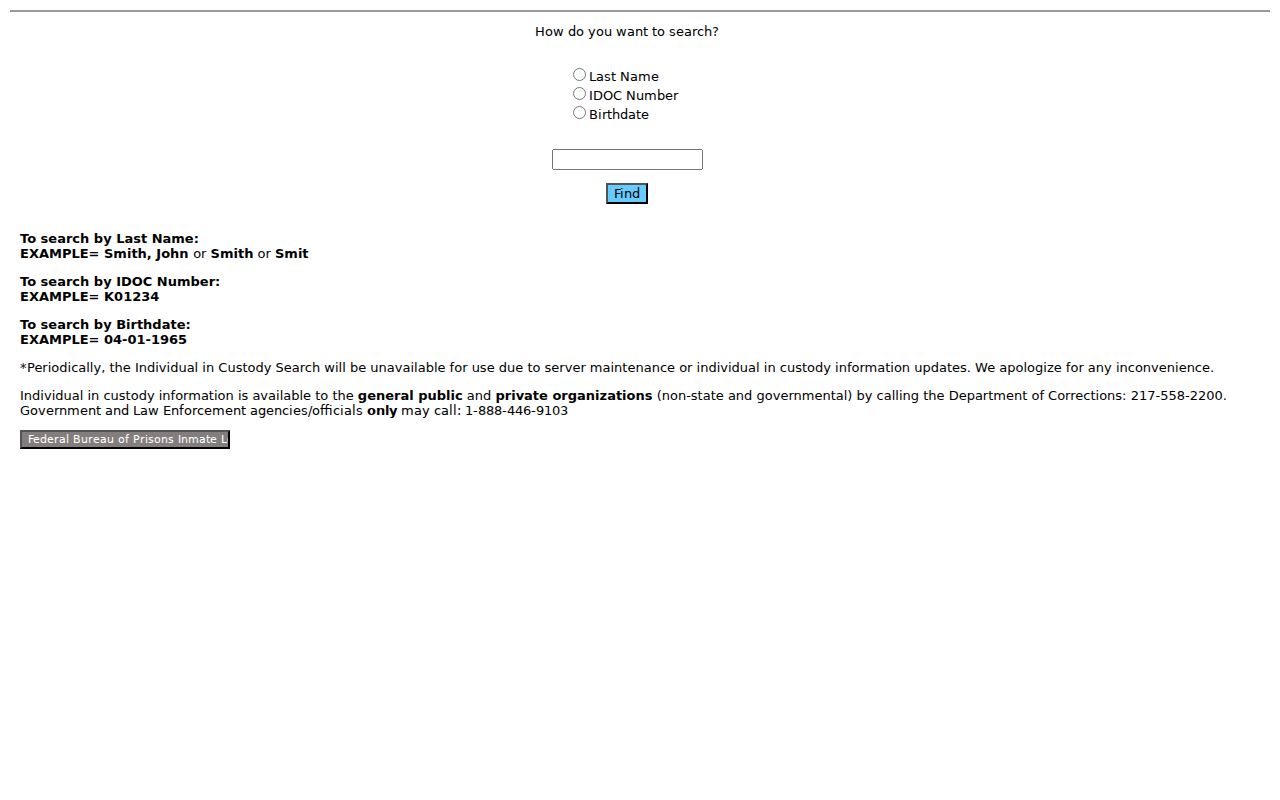 The Illinois result can show public identifiers, status, location, admission and release fields, and sentencing information, but it is not a complete historical arrest archive.
IDOC reports and statistics provide statewide context. FY2025 materials report 29,430 adults in custody on June 30, 2025 and 15,294 adults on parole. 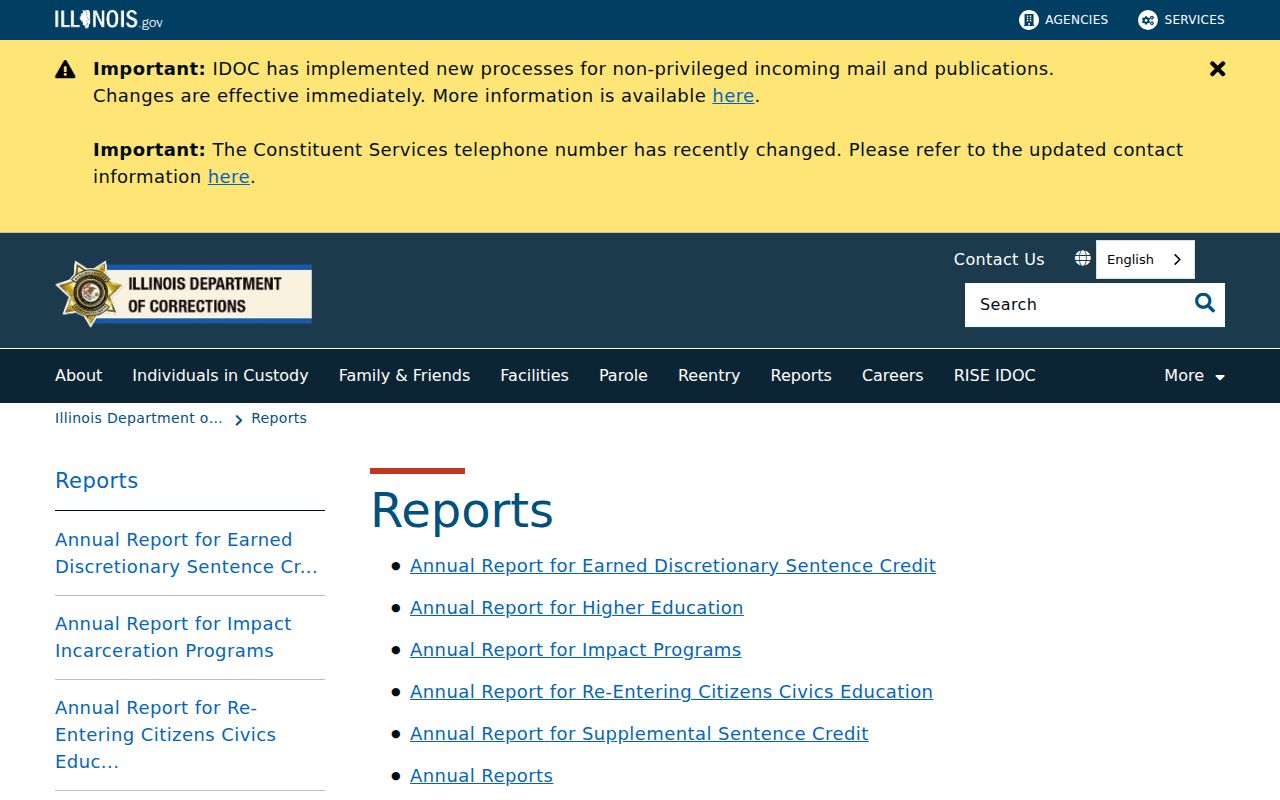 Those Illinois totals describe corrections populations, not the number of criminal records or cases in Illinois.
For federal custody, the BOP Inmate Locator searches by register number or by name and descriptors. 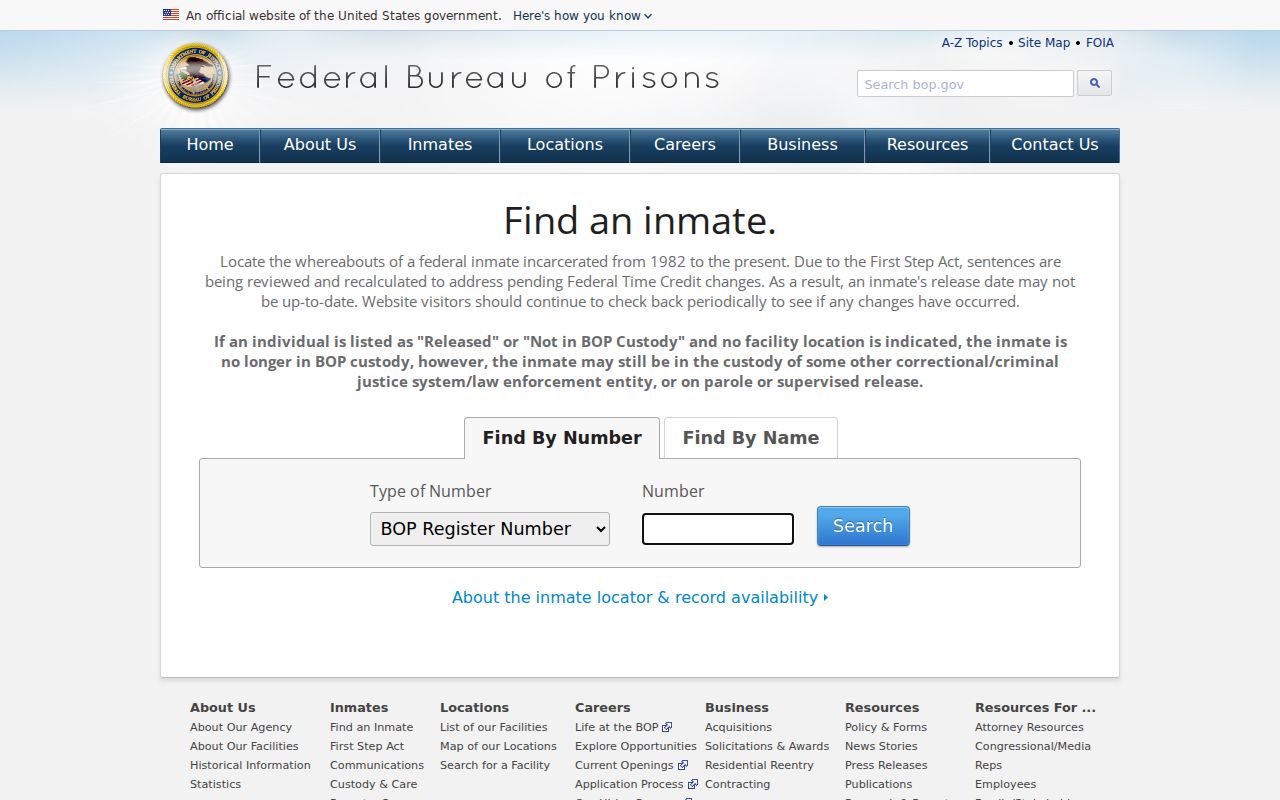 The federal result sits outside CHIRP, IDOC, and Illinois circuit-court systems.
Illinois Criminal Record Types
An Illinois arrest report, booking, charge, court case, and rap sheet are related but not interchangeable. The Illinois arresting agency writes the incident narrative. An Illinois county jail creates custody intake. The State's Attorney determines filed counts. The Illinois circuit clerk maintains the prosecution. ISP compiles reportable identity and outcome events. A warrant is held in restricted law-enforcement systems, while a public docket may reveal a warrant event.
- Arrest cycle
- Arrest charges and later dispositions linked to one fingerprint transaction.
- SID
- The Illinois State Identification number attached to a fingerprint-supported subject record.
- TCN
- The Transaction Control Number for one CHIRP or fingerprint submission.
- Disposition
- The result of a charge, such as conviction, dismissal, acquittal, supervision, or nolle prosequi.
- Sealing
- Restriction from ordinary public access while authorized access remains.
- Expungement
- Statutory removal, destruction, or return of eligible records.
The Illinois ISP record-types page separates reports and other agency holdings by channel.
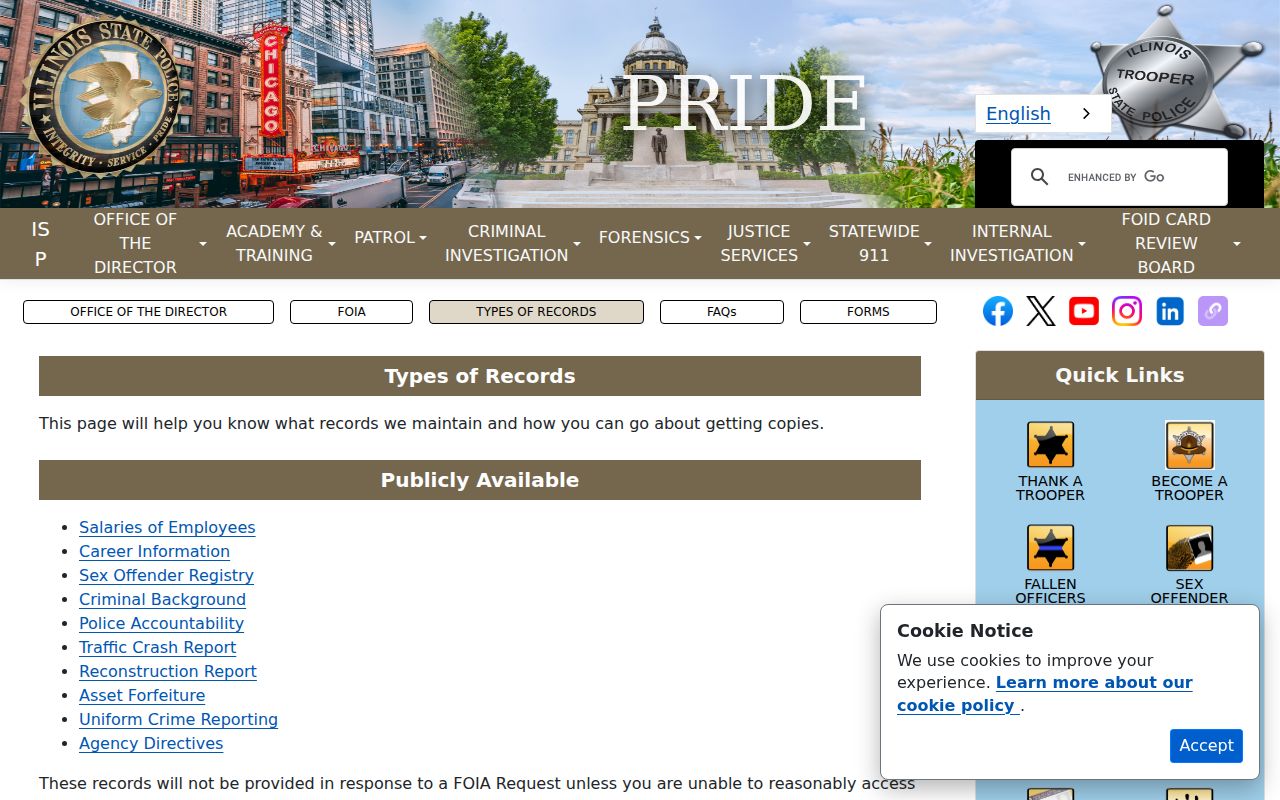
That division helps prevent a request for an Illinois municipal report or Illinois county pleading from going to the state repository.
Note: Ask for the exact Illinois record type, not merely a background check, when contacting the source office.
Illinois Warrants Stay Local
Illinois does not offer a comprehensive public statewide warrant lookup. LEADS and NCIC hold wanted-person data for authorized law enforcement. Public checks route to the issuing circuit or municipal court and the county sheriff. A docket may show warrant or capias events, but active, sealed, juvenile, or investigation-sensitive information may remain restricted.
The ISP LEADS overview documents the law-enforcement system boundary.
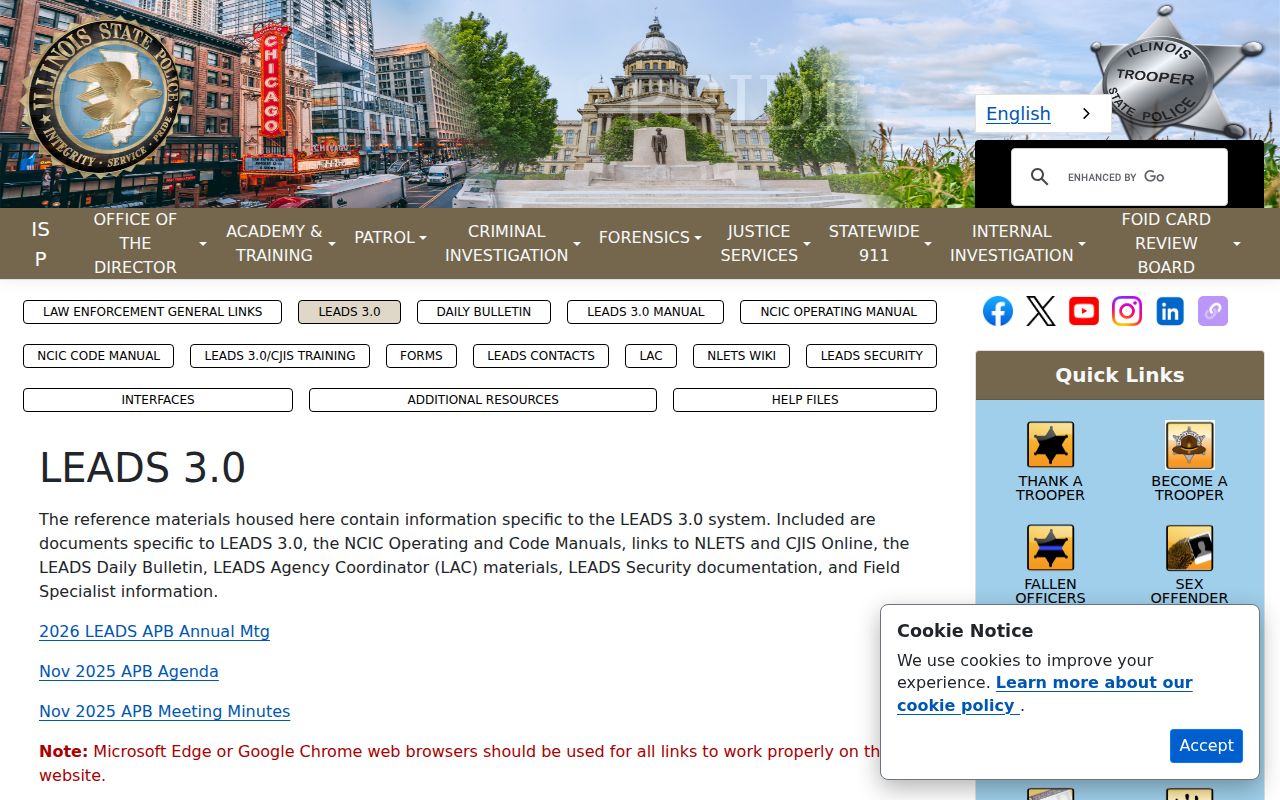
The public should not treat that restricted system as a missing consumer portal. Use the issuing clerk, sheriff, or counsel to confirm and address a possible warrant safely.
Possible warrant: Do not test an unofficial result in person. Contact the issuing court, holding sheriff, or a lawyer about status and safe appearance.
Illinois Probation and Parole Split
Probation is local. The Illinois Courts Probation Services Division supports 69 departments or districts serving all 102 counties in 25 circuits, but the sentencing county handles a person's probation case. The state probation directory routes users to those departments. 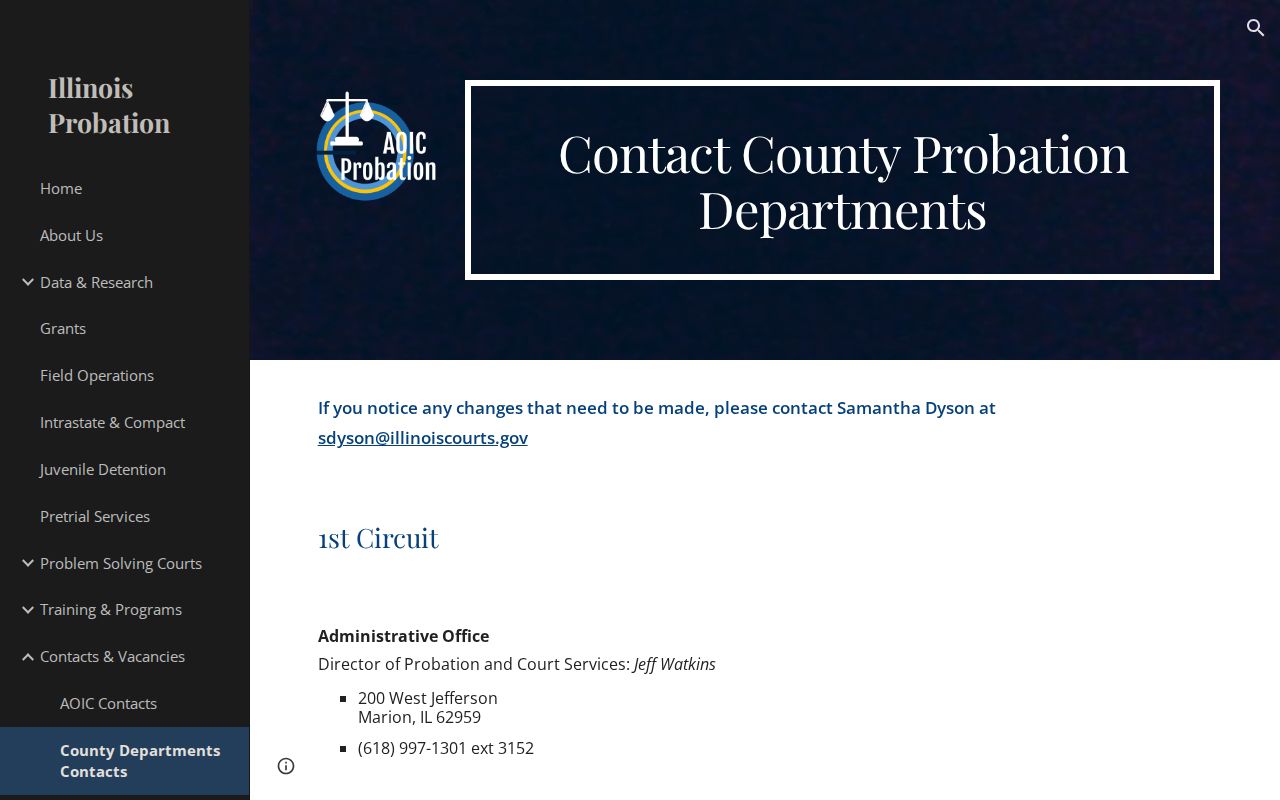 The directory reflects a statewide framework with local supervision and records.
Parole and mandatory supervised release cross two state bodies. IDOC's Parole Division supervises in the community. The Illinois Prisoner Review Board sets conditions and handles revocation and selected release matters. 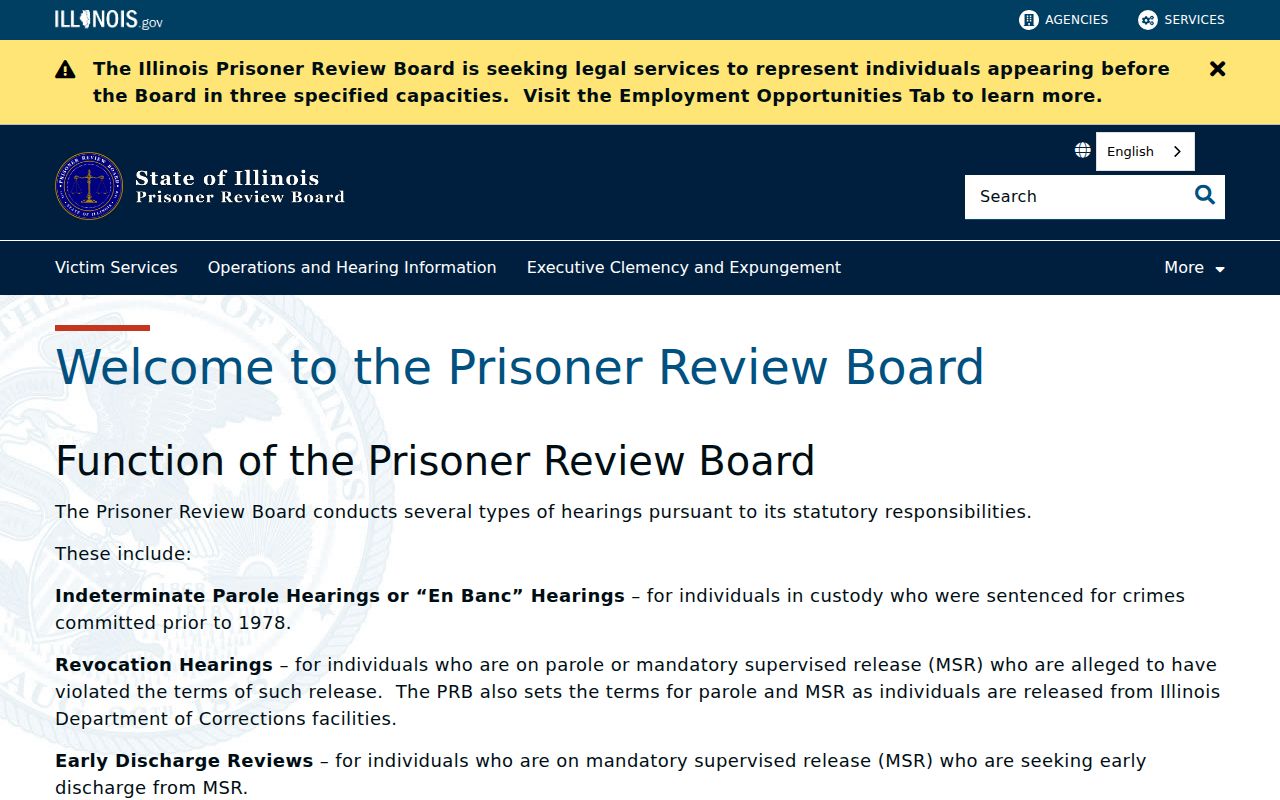 A sentencing docket, IDOC locator entry, and PRB proceeding can therefore contain different parts of one supervision history.
Note: Illinois probation and parole records come from different offices, even when both describe community supervision.
Reading Illinois Case Codes
Illinois uses one general-jurisdiction Circuit Court system. Local divisions and case codes help identify the filing: CF commonly marks criminal felony, CM criminal misdemeanor, DT DUI, TR traffic, and OV ordinance. A closed case status does not mean convicted. The charge-level disposition and final order control.
Illinois offense classes range from first-degree murder and Class X through Class 4 felonies, then Class A, B, and C misdemeanors. Ordinary sentencing ranges can change through offense-specific rules, enhancements, and consecutive terms. The class alone cannot establish the exact sentence or whether a record qualifies for sealing. Read the statute, judgment, and current relief law together.
Court supervision is another Illinois-specific reading issue. Successful supervision may withhold a judgment of conviction, but eligibility and later relief depend on the offense and order. Nolle prosequi means the prosecutor stopped a charge at that time. It is not the same docket event as an acquittal. A case can also contain convicted, amended, dismissed, and supervised counts at once. Read each count, then obtain the signed final order when a short online status leaves the result unclear.
Illinois Record Access Laws
Access depends on the record holder and the product. The Illinois Freedom of Information Act governs executive and local public-body records subject to exemptions. UCIA creates the public ISP conviction channel. The Criminal Identification Act protects broader BOI files while allowing verified self-review and correction. Illinois Supreme Court rules govern court access, which is distinct from executive FOIA.
Key Illinois laws:
5 ILCS 140 provides public-record access subject to exemptions and ordinary response rules.
20 ILCS 2635 makes prescribed ISP conviction information available through UCIA.
20 ILCS 2630/7 limits BOI file disclosure while supporting verified personal review and correction.
Illinois Supreme Court Rule 8 governs court document accessibility and confidentiality designations.
20 ILCS 2630/5.2 controls expungement, sealing, automatic sealing, and authorized access.
FOIA cannot unlock a sealed court file, confidential juvenile matter, protected victim data, or an open investigative file that meets an exemption. Ask the office that created the record.
Illinois Police Report Requests
ISP FOIA covers reports for incidents investigated by ISP. City and sheriff reports remain with the local agency. A focused request should provide the report number when known, date, place, involved person, and a clear description of the desired document or recording. Broad requests can be burdensome, while active investigations, victim privacy, juvenile facts, and personal identifiers may require withholding or redaction.
ISP has a separate crash-report E-Pay channel for crashes investigated by state police.
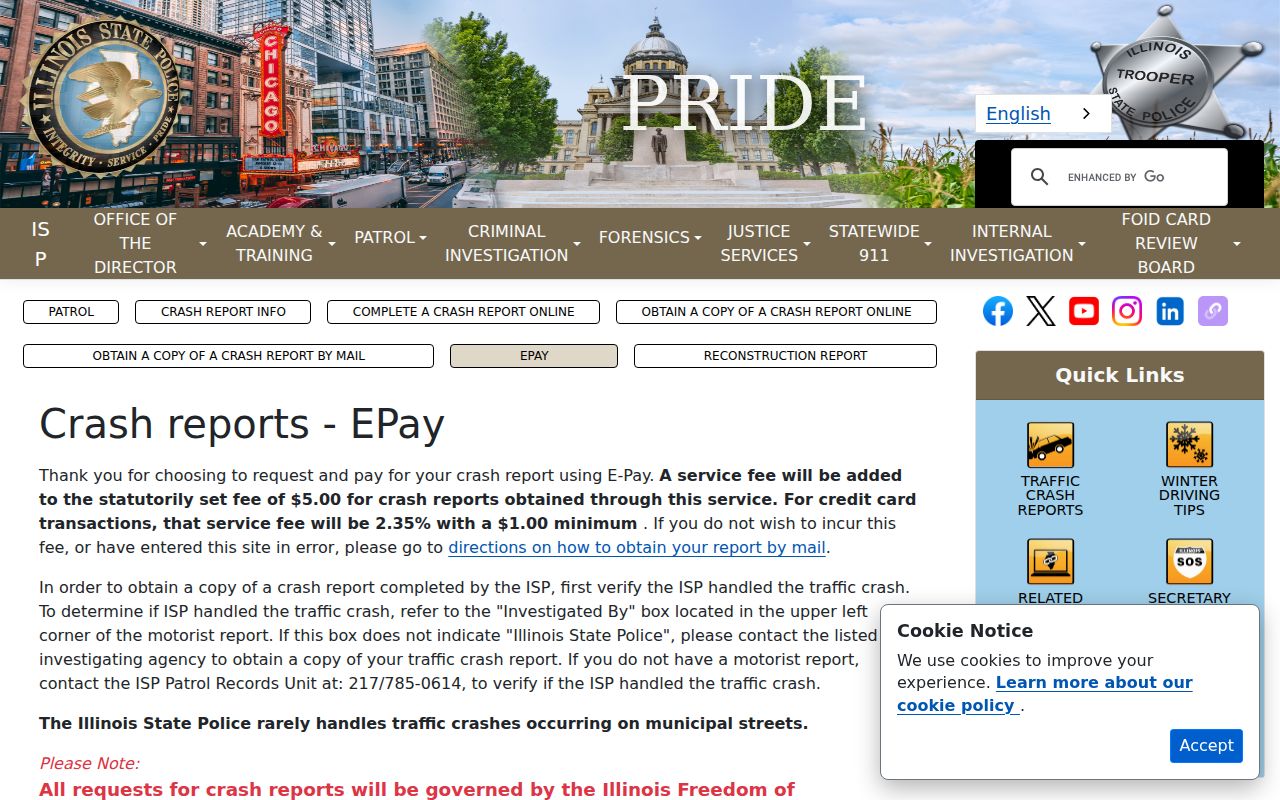
The $5 statutory report fee does not buy every Illinois crash report; municipal and county crashes must be requested from the investigating agency.
Illinois Clean Slate Timeline
Illinois distinguishes expungement from sealing. Eligible records may be removed as the statute directs through expungement, while sealing restricts ordinary public access but preserves access for authorized bodies. Petitions use approved statewide forms and are filed with the circuit clerk in each county holding the record. Fees vary by county, and a court-fee waiver may be available.
The Illinois Courts form suite is accepted statewide. 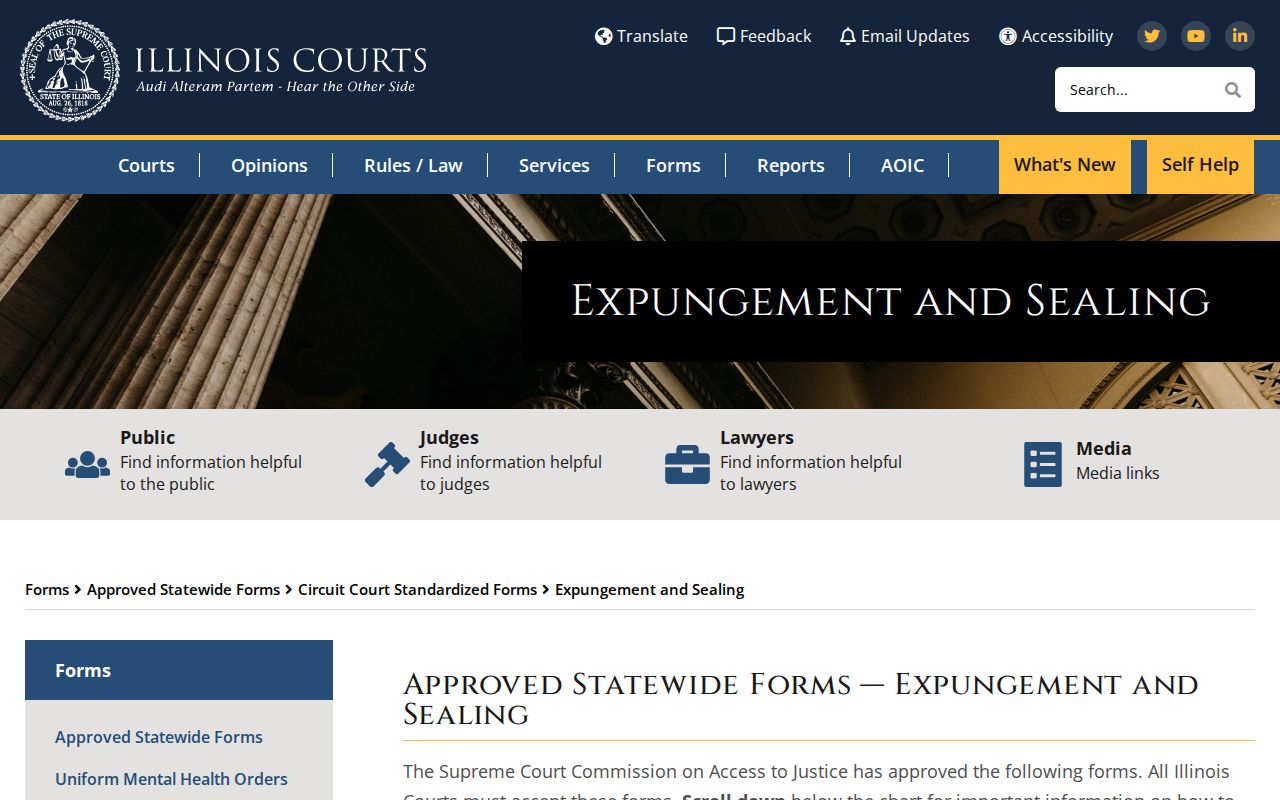 The forms organize cases by county because relief is implemented through the courts and agencies holding each source record.
The Clean Slate Act provisions in 20 ILCS 2630/5.2 phase in automatic sealing work through 2028, 2029, and 2030. 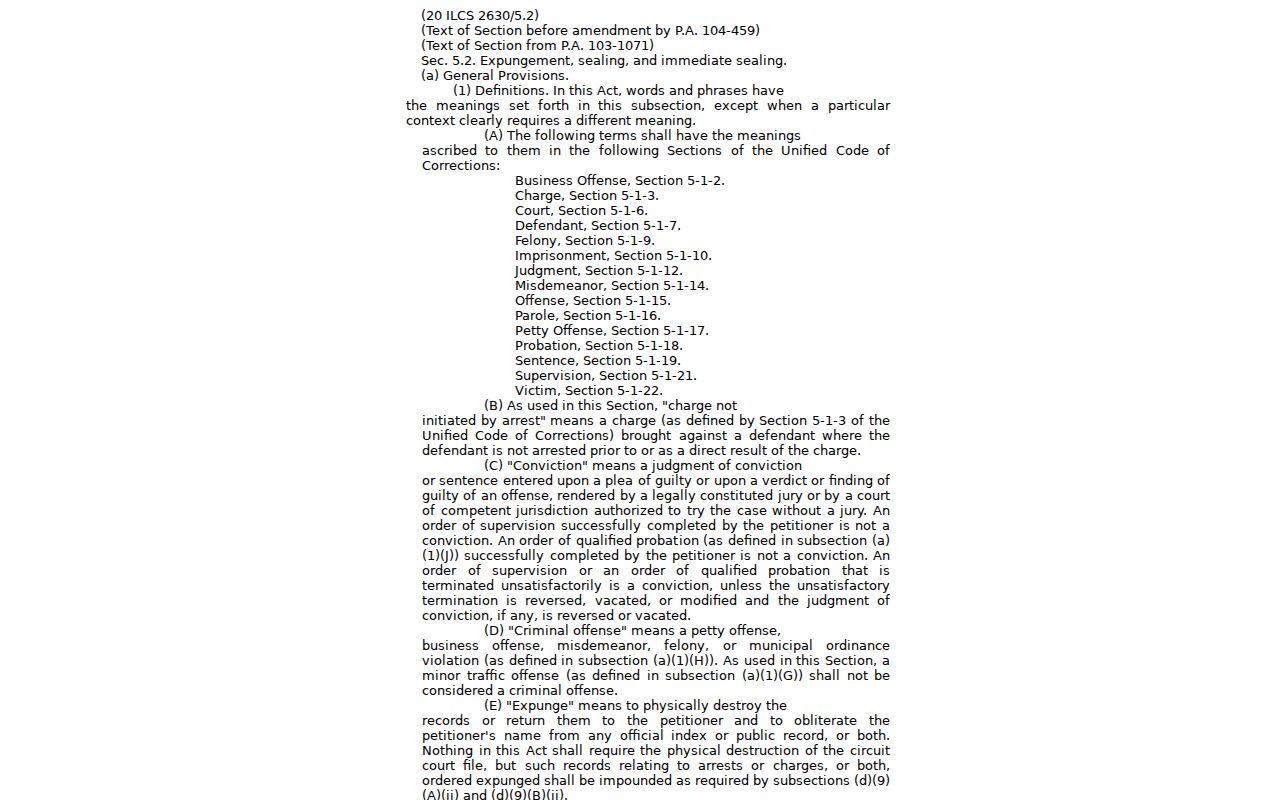 Those future dates do not mean every eligible old record is already sealed. Statutory exclusions and data-quality work still matter.
Note: Verify Illinois sealing or expungement through Access and Review and the court that entered the order.
Illinois Record Fees Compared
Costs depend on the channel, and one payment rarely buys every layer. CHIRP electronic name inquiries cost $10. Manual name requests cost $16. Electronic UCIA fingerprint processing is $15, apart from the vendor capture fee. ISP Access and Review has no ISP processing charge. The FBI direct Identity History Summary costs $18. A court order to expunge or seal carries a $60 ISP implementation fee, while county filing charges are separate.
| Channel | Base Fee | What Is Separate |
|---|---|---|
| CHIRP electronic name | $10 | Not a county court copy |
| Manual UCIA name | $16 | Mailing |
| Electronic UCIA fingerprint | $15 | Live-scan vendor charge |
| ISP Access and Review | $0 ISP | Vendor capture fee may apply |
| FBI direct summary | $18 | Capture, mailing, or channeler charge |
| Circuit-clerk documents | Varies | County search, copy, and certification fees |
Ask for the total before paying a live-scan vendor, and confirm county copy charges with the filing clerk.
Illinois Criminal Records by County
Arrests, bookings, reports, and trial-court files begin with local agencies. Each Illinois county has its own criminal-record site in the directory, using the folder-backed county subdomain. The eight largest counties below provide the main metro routes, but all 102 are available in the full A-Z list.
Cook County
Chicago · Illinois's largest unified county court and jail system
DuPage County
Wheaton · 18th Circuit case and docket services
Lake County
Waukegan · county portal and formal record-search routes
Will County
Joliet · limited public case-management lookup
Kane County
Geneva · clerk search and case reminder tools
McHenry County
Woodstock · case, copy, date, and warrant-status routing
Winnebago County
Rockford · 17th Circuit current case information
Madison County
Edwardsville · participant, case-number, and archive channels
Browse the full directory of all 102 Illinois counties to open the criminal records site for any county.